Justlend energy rental turns amount, duration and recipient choices into a time-bound TRON Energy order
Updated ·
Justlend energy rental lets a payer choose how much TRON Energy a regular account receives and for how long, then prepay in TRX. Before signing, compare the live prepayment and likely refund with the TRX the intended contract call would burn without enough Energy. Finish by returning the order before expiry and checking the refund, remaining deposit and rental status.
The choice fits best when the required Energy, recipient and usage window are known. An uncertain transaction estimate or unmanaged exit time can lead to unused capacity, a deposit deduction or liquidation.
Fit begins with the recipient and use window
A rental fits when a known account needs temporary Energy for a defined set of TRON contract calls. The receiving address must be an activated regular account rather than a contract address. The payer may allocate Energy to the connected account or another eligible account, so payment responsibility and resource use can sit at different addresses.
Weak estimates create the main mismatch. A contract call may consume more Energy than an earlier or superficially similar transaction because its execution and contract state differ. Estimate the intended operation first, then set a term covering its actual use. A remembered quote from another transaction does not establish either input.
Different jobs require different stopping points
Each use receives the same TRON resource, but the required amount and return point depend on the workload.
- One bounded contract call suits a measured Energy requirement and a narrow use window. Available Energy at the receiving account is the relevant outcome, while estimation error is the principal limit. The order no longer serves that job after the call finishes.
- A fixed batch of calls requires enough Energy for the combined workload. The batch is complete only when its last intended transaction confirms. Extra calls change the demand and can invalidate the amount chosen at the start.
- Repeated activity can use an allocation again as consumed Energy recovers. Its fit depends on the daily workload and a term long enough to cover it. The single-rental duration cannot exceed the service limit shown for the order.
- Renting for another account directs Energy to a separate eligible recipient. The receiving address shows the added Energy, while the payer retains the funded rental relationship. A wrong recipient cannot be corrected by checking only the payer's resource balance.
These uses share the same inputs, but they do not share one universal duration. The next decision is whether the expected workload ends after a call, after a batch or after a recurring activity window.
Three order fields set the quote
The rental amount starts with the target Energy requirement. JustLend converts that target through the live relationship between Energy and delegated TRX. Because the relationship can move during submission, the amount received may differ slightly from the entered target. A fresh estimate matters most when the planned call leaves little spare capacity.
Duration controls the time-based portion of the cost. Orders support hour or day terms up to the displayed single-rental limit, which documentation caps at 30 days. Short terms leave less room for quote movement, confirmation delay and a managed return.
The receiving address determines where TRON allocates the resource. Self-use connects the order with the payer's own account, while third-party use needs the intended recipient entered explicitly. The prepayment contains an Energy fee, a security deposit and a liquidation penalty. Review those components separately because only part of the amount represents expected rental consumption.
A hypothetical quote sets a measurable boundary
Every changing input and quote value in this worked example is hypothetical. A tester estimates one contract call at 312,503 Energy, selects an activated receiving account and chooses a 27-hour term. The refreshed rental quote requires 81.3 TRX upfront. Under a full-recovery return before expiry, 65.1 TRX is projected to come back.
The rental setup and return transactions are estimated to add 1.6 TRX to the rental path. Expected retained cost is therefore 81.3 minus 65.1 plus 1.6, or 17.8 TRX. A direct-burn estimate for the same call is 18.7 TRX. Both paths exclude the same Bandwidth cost for the intended call, so the hypothetical rental margin is 0.9 TRX.
The tester proceeds only if refreshed values preserve that margin. After the call confirms, the stop condition is the receiving account's Energy recovery before the 27-hour expiry. Before closing, the tester refreshes the return estimate, then verifies the credited refund and closed rental record after confirmation. A different recovery reading, refund estimate or burn rate requires a new comparison rather than an automatic repeat.
Prepayment and TRX burn measure different costs
Prepayment is the TRX required to open the rental, not the final amount spent. The Energy fee accrues with time, while the security deposit and liquidation penalty are conditionally refundable reserves. An early return can refund unused prepaid rent, but Energy use, delayed return and liquidation can reduce what comes back.
The direct-burn path begins with the Energy shortfall for the exact transaction. TRON burns TRX when an account lacks enough available Energy for a smart contract call. The estimate must use the current resource price, the expected execution, the caller's available Energy and any contribution the contract deployer provides. A nominal transfer amount alone does not reveal that cost.
Bandwidth remains a separate transaction resource. Renting Energy does not automatically cover every Bandwidth requirement for opening the order, performing the intended call or returning the rental. If the account lacks the required resources, TRX may still be burned for the shortfall.
A sound comparison places expected retained rental cost beside the direct burn estimate for the same transaction and account state. For this cost comparison, the rental remains preferable only while a refreshed quote and the planned return keep its expected retained cost below the direct-burn estimate.
Live limits and confirmation prevent false starts
Live parameters determine whether an order can proceed. Check the service pause state, allowed amount, maximum rentable capacity, current rate and required TRX balance immediately before signing. Minimums and available capacity can change, so a figure saved from an earlier session should not control a new order.
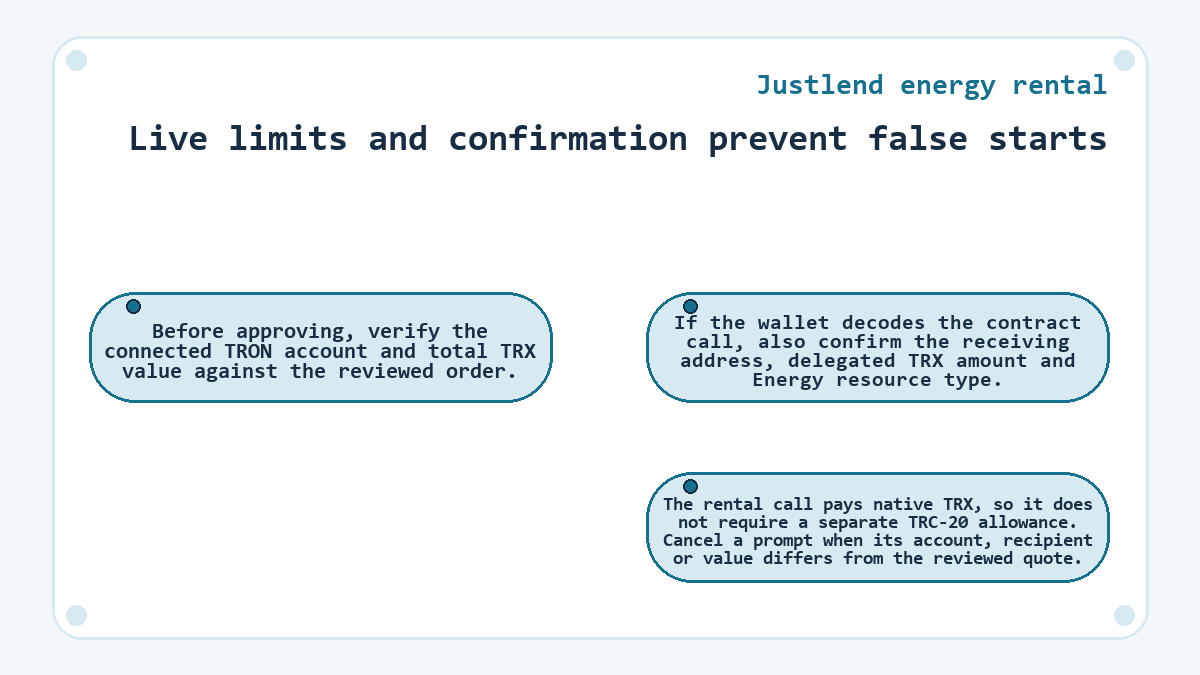
Before approving, verify the connected TRON account and total TRX value against the reviewed order. If the wallet decodes the contract call, also confirm the receiving address, delegated TRX amount and Energy resource type. The rental call pays native TRX, so it does not require a separate TRC-20 allowance. Cancel a prompt when its account, recipient or value differs from the reviewed quote.
Confirmation should leave two matching observations: additional available Energy at the receiver and an active rental record for the payer-recipient pair. If either remains unchanged, inspect the transaction result and live order state before attempting another submission. Repeating an uncertain write can create an unintended second commitment.
Return state controls the final refund
The return estimate should be read before the exit signature. It reflects the remaining rent, current security deposit, unrecovered Energy and projected refund. Ending early does not automatically restore every prepaid component, because the contract accounts for how long the order ran and how much of the used resource has recovered.
Consumed TRON Energy recovers gradually over a 24-hour window. Returning delegated resources before recovery completes can therefore reduce the security deposit. Waiting for recovery can improve that part of the refund, but the order continues to accrue time-based rent while it stays open. Compare the extra rent from waiting with the deposit deduction shown by the current return estimate.
Return the order before expiry to avoid charges for the exceeded duration and the risk of liquidation. If the remaining security deposit becomes insufficient, a liquidator can trigger removal of the delegated resources; the contract then settles accrued rent and pays the liquidation reward from the reserve. Any remaining deposit goes back to the payer under the contract rules.
The final check is a closed or reduced rental record, the expected change in the receiver's Energy and the credited TRX refund. Choose between immediate return and additional recovery time while the order still has enough time and deposit to support that choice.
Questions and answers about Justlend energy rental
-
Can the receiving account close a rental it did not pay for?
- Yes. The rental contract provides a receiver-side return path as well as a payer-side path. The caller must identify the counterparty associated with the active order. Before signing, the receiving account should inspect the return estimate and confirm the intended payer-recipient pair because the operation removes delegated resources from that relationship.
-
Does a partial return release the security deposit?
- No. Under the contract's partial-return behavior, the operation reports no deposit refund until the resources tied to the order are fully returned. A partial return still reduces the rental amount. Read the remaining amount and current deposit after confirmation so the reduced order is not mistaken for a completely closed rental.
-
How are rentals to several receiving accounts kept separate?
- Each order is associated with its payer, receiving account and resource type. One payer can allocate Energy to multiple eligible accounts, but each payer-recipient relationship has its own order state. Check the recipient before every increase, extension or return because a matching amount does not prove the interface selected the intended relationship.
-
Can an expired rental still be returned before liquidation?
- Yes, if the order has expired but has not yet been liquidated, the return path may still close it. Accrued charges continue to reflect the exceeded duration and Energy recovery state, so the refund can be smaller. Use the displayed return estimate and do not assume the order includes a fixed grace period.
-
Does rented Energy remove the transaction Fee Limit?
- No. Rented Energy increases the resource available to the receiving account, while Fee Limit still caps the Energy budget for a TRON smart contract call. The transaction can fail if its execution requires more than the permitted budget. Set the limit from a current estimate rather than from the rented balance alone.
-
Does adding more Energy automatically extend the rental term?
- No. Increasing the Energy amount and extending the duration are separate order changes. Additional Energy on an active rental uses the order's remaining time unless the duration is also extended through the relevant action. Read the incremental prepayment and updated expiry before signing because the original quote no longer describes the enlarged order.