Justlend requires live compatibility and limit checks before lending, staking or renting Energy
Updated ·
Justlend is a decentralized TRON protocol for supplying assets, borrowing against collateral, staking TRX for sTRX and renting network Energy. Before signing, confirm the wallet network, selected market, supported asset, available liquidity and live risk parameters. Signing authorizes the action, but confirmation and refreshed state are still needed to verify completion. Read the resulting balances, debt, collateral status or rental record before continuing, because rates, exchange values and borrowing capacity can move after confirmation.
The short version: Justlend actions depend on compatible wallets, live market limits and confirmed account state before the next transaction is signed.
Position readiness before the first signature
Every figure in this example is hypothetical. A V1 account has supplied collateral worth 124 accounting units. Its collateral market has a hypothetical 54% collateral factor and the account has no debt. The resulting borrowing power is 66.96 accounting units.
Before borrowing, the reader confirms the wallet is on TRON, the asset belongs to a listed market and the supply transaction is final. The position must also show collateral as enabled. Available market cash and the current account-liquidity reading provide the final readiness signals.
Suppose the account borrows a hypothetical 40.4 accounting units. Once the transaction confirms, the refreshed account state should show the recorded debt and collateral position. At the illustrative starting values, unused borrowing power is 26.56 units before any further interest accrues.
Now the hypothetical oracle value falls by 12%. Collateral value becomes 109.12 units, while borrowing power falls to 58.9248 units. The remaining cushion is 18.5248 units before additional interest. The position is still within the hypothetical limit, although its margin has narrowed.
If the refreshed record instead shows a shortfall or unexpected debt, further borrowing should stop. Repaying part of the balance or adding eligible collateral can restore room. The account-liquidity reading must then be checked again before another transaction is signed.
Borrowing power and the liquidation boundary
Borrowing power combines eligible collateral, market parameters and oracle valuations. It is neither the wallet's full asset value nor a permanent credit line. Five live fields determine whether another borrow fits:
- whether the supplied asset is enabled as collateral
- the market's collateral factor or liquidation loan-to-value
- the oracle value assigned to the collateral and borrowed asset
- available market cash and any configured borrow cap
- existing debt after accrued interest
Collateral eligibility
V1 requires a supplied market to be entered before its balance counts as collateral. Merely holding jTokens does not establish borrowing power. V2 binds collateral to a particular isolated market, so value posted in one market does not automatically secure debt in another.
Liquidity and market caps
Account capacity and market availability answer different questions. A wallet may have enough collateral value while the requested loan asset lacks available liquidity. Governance can also place an exposure cap on a market. Either condition can limit the amount even when the account itself has room.
Liquidation conditions
V1 becomes liquidatable when debt exceeds the amount permitted by eligible collateral. V2 becomes liquidatable when the loan-to-collateral ratio exceeds that market's liquidation loan-to-value. A liquidator can repay part of the debt and receive collateral under the configured incentive. Price movements and interest accrual can move either version toward its liquidation boundary. V1 governance can also change risk parameters, while each V2 market keeps its original parameter set.
Supplying assets and jToken accounting
Supplying places an underlying asset in a market's liquidity pool and creates a claim on that pool. A V1 supply creates jTokens whose exchange rate against the underlying asset increases as interest accrues. The wallet holds those receipt tokens while the pool handles borrowing, repayment and redemption.
The jToken quantity and its underlying value are different measurements. V1 jTokens use eight decimal places, while each underlying asset keeps its own precision. Interest usually appears through a higher exchange rate rather than a matching increase in receipt-token count. A TRC-20 supply also requires an allowance before the market contract can transfer the selected amount.
How do rates change while a position is open?
Supply and borrow rates change with each market's utilization and interest-rate model. Utilization compares outstanding borrows with usable pool liquidity after reserves. Rising demand can move the borrow rate along the configured curve, while repayments or new supply may move it in the other direction.
Borrower interest funds supplier interest after the protocol retains its reserve share. The supply rate reflects current utilization, the borrow rate and the reserve factor. Separate incentive rewards may appear for selected markets, but they are not the same as lending interest. A displayed annual rate describes the current market state. It does not lock that rate for the remaining life of a supply or debt position.
Repayment, withdrawal and reserve cash
Closing or reducing a lending position involves separate debt, collateral and liquidity checks. Success in one area does not remove the other constraints.
Reducing the debt balance
A repayment lowers the current borrow balance, including interest already accrued. The required amount should come from a refreshed position rather than an earlier snapshot. TRC-20 repayments may require an allowance, while native TRX repayment passes value with the transaction.
Releasing collateral
Withdrawing supplied collateral or disabling its collateral status reduces borrowing power. The protocol checks account liquidity before allowing that change. A smaller withdrawal may succeed where a full redemption would leave the remaining debt outside its permitted limit.
Available pool cash
A valid receipt-token balance does not reserve a separate pile of underlying assets. Other accounts may have borrowed part of the pool. Redemption therefore depends on both the account's collateral position and the market's available cash when the transaction executes.
V1 pools and V2 isolated markets
The protocol exposes pooled V1 lending and isolated V2 markets. Their different risk boundaries affect how collateral, debt and supply claims fit together.
V1 cross-market accounts
V1 follows a jToken model managed through a shared Comptroller. Each asset has its own liquidity pool, while eligible supplied assets can contribute to one account-level collateral calculation. This arrangement makes the combined account important: a value change in one enabled collateral market can affect borrowing room elsewhere.
V2 market-specific risk
A V2 market is defined by its loan token, collateral token, oracle, interest-rate model and liquidation loan-to-value. Risk stays within that market rather than joining the V1 collateral account. Supply vaults can allocate deposited liquidity across isolated markets and issue ERC-4626 shares. The selected market configuration therefore matters as much as the asset name.
What changes when TRX becomes sTRX?
Staking TRX changes the position from native TRX into sTRX, a TRC-20 receipt with a live pool exchange rate. One sTRX does not necessarily correspond to one TRX, so the current rate determines the underlying value.
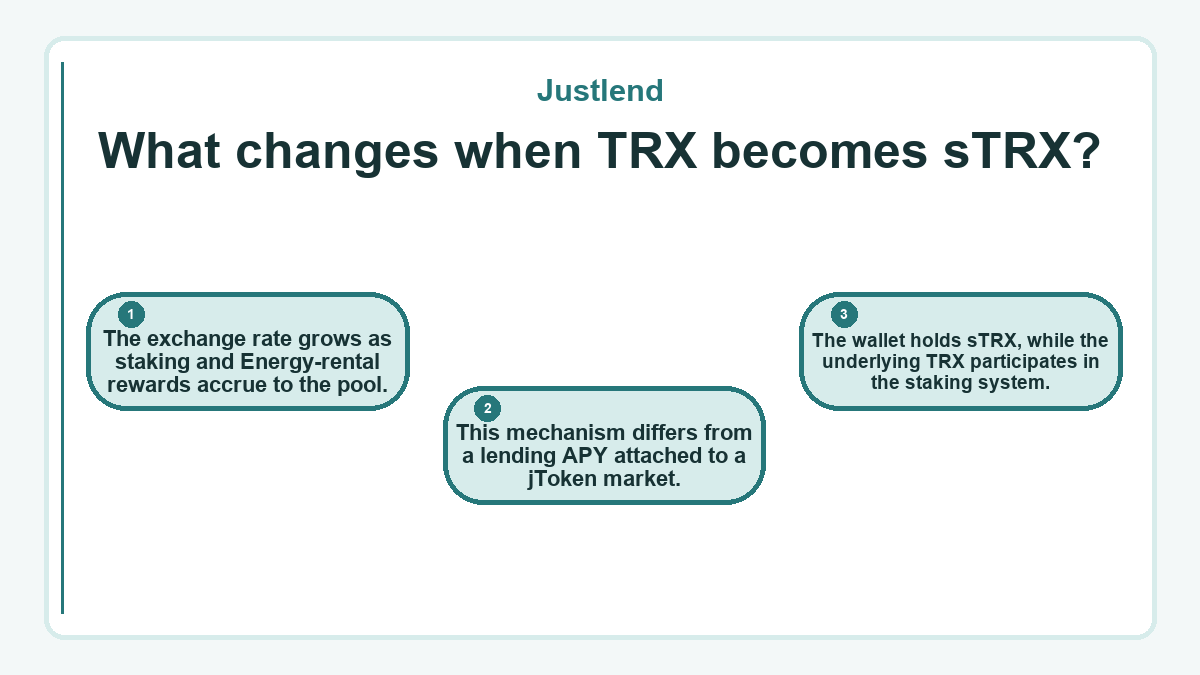
The exchange rate grows as staking and Energy-rental rewards accrue to the pool. This mechanism differs from a lending APY attached to a jToken market. The wallet holds sTRX, while the underlying TRX participates in the staking system.
Protocol unstaking starts an unbonding process rather than an immediate TRX transfer. A later claim releases the available TRX after the withdrawal becomes eligible. Until that state appears, a pending withdrawal should not be counted as spendable wallet balance.
Energy rental on TRON
Energy rental delegates TRON network Energy to a regular account for a chosen amount and duration. The renter prepays in TRX, with the calculation covering rent plus amounts reserved for deposit and liquidation conditions. The receiving address may belong to the renter or another user, but it cannot be a contract address. A single Energy rental is capped at 30 days. Market movements can change the delivered amount or effective usage time slightly, so the confirmed order is the useful record.
Wallet permissions, transaction costs and privacy
Wallet compatibility starts with TRON Mainnet and the correct account. TRC-20 approvals can authorize a protocol contract to spend tokens, so the asset, spender and amount deserve review before signing. TRON transactions consume Bandwidth and Energy; a wallet without enough resources may spend TRX instead. Addresses, balances and transaction amounts remain public on-chain, so privacy depends on keeping wallet activity separate from personal identity.
Governance and the final state check
JST-based governance can change supported markets, collateral factors, reserve settings and interest-rate models. Utilization changes rates without a governance vote, while oracle movements can change account capacity. Compatibility is therefore a reading of live protocol state rather than a permanent property of an asset.
After any transaction confirms, compare its receipt with refreshed balances and the intended market. A supply should show its receipt position, a borrow should show debt, staking should show sTRX and a rental should show its receiving account and duration. If the recorded state matches the intended action, the next decision is whether to hold, reduce or close the position under the live limits.
Practical questions about Justlend
Can one wallet repay another account's Justlend loan?
The V1 contracts can repay debt on behalf of another borrower. The payer needs the correct underlying asset, enough balance and any required TRC-20 allowance for the relevant market. Repayment reduces the borrower's debt; it does not transfer the payer's collateral or grant control over the borrower's account. A user interface may expose fewer choices than the underlying contract, so confirm the borrower and repayment amount in the transaction details.
Does a partial repayment separate principal from accrued interest?
A partial repayment reduces the total outstanding debt and cannot be assigned only to principal or only to interest. Accrued interest is already part of the balance. Multiple payments are permitted, but a balance read earlier may change before confirmation. Refreshing the amount before a final payoff avoids assuming the position is closed when a small residual debt remains.
Is unused Energy-rental prepayment refundable after a timely return?
Returning a rental on time can refund part of its prepayment. An early return refunds the unused Energy fee in proportion to unused time. The security deposit refund depends on Energy recovery, while an on-time return refunds the liquidation penalty reserve. The amount depends on how long the rental remained active, its state at return and live contract parameters. The final wallet balance and closed rental record show what the contract returned.
Does rented Energy recover after it is consumed?
Consumed TRON Energy recovers over 24 hours and can be used again while the delegation remains active. Recovery does not extend the selected rental duration or reopen a returned order. If the rental ends first, the receiving account loses the delegated capacity. Contract calls also consume different amounts, so one transaction's usage cannot define every later requirement.
Do I need to convert JST before voting on a proposal?
JST must be deposited into the WJST voting wrapper before it provides on-chain voting power. The deposit requires a sufficient JST allowance for the WJST contract. The conversion is one-to-one, while voting rules determine how the resulting votes are committed and later released. This governance action is separate from supplying an asset as lending collateral. Read the proposal state and available voting balance before signing, because votes committed to an active proposal remain locked until they become withdrawable.
Can sTRX be exchanged before a protocol withdrawal becomes claimable?
sTRX can be swapped on a third-party decentralized exchange before a protocol withdrawal becomes claimable, provided a suitable market has liquidity. That route is a market trade, not the staking pool's unstaking process. The TRX received depends on price, slippage and available depth. Protocol unstaking follows its own unbonding and claim stages instead, so the two exits can produce different timing and amounts.